
Rollei's professional rectangular filters have earned an excellent reputation thanks to their workmanship and durability.
The latest generation of slot-in filters therefore had to prove their quality immediately after product maturity – on a USA trip that took Rollei CEO Thomas Güttler and his team from San Francisco across the snowy Yosemite National Park to the scorching heat of Death Valley.
On their journey, the photo professionals stopped at impressive natural spots.
#1: The Golden Gate Bridge in San Francisco
#2: The Tunnel View in Yosemite National Park
#3: The Tufa Formations at Mono Lake
#4: Devil's Golf Course in Death Valley
#5: Zabriskie Point in Death Valley
In spring 2019, Rollei CEO Thomas Güttler and members of his team packed their travel and camera bags to embark on a highly exciting and challenging USA tour.
After landing at San Francisco International Airport (California), the travelers were met by photo professional and location guide Paul Reiffer. There has been a friendly and very productive connection with the landscape photography expert for many years. For this trip, the British native had come up with a particularly diverse route.
#1: The Golden Gate Bridge in San Francisco
After the greeting, they went directly to a viewpoint at the world-famous Golden Gate Bridge. There, the sophisticated steel structure was to be photographed before sunset with the new F:X PRO filters made of Gorilla® Glass in the rectangular filter holder.

Subject: Golden Gate Bridge, California
Coordinates: L: 37.809 | B: -122.470
Filter: ND64 Neutral Density Filter
Exposure: Aperture 11 at 60 seconds
Camera: Fujifilm GFX 50S
Lens: GF23mmF4 R LM WR
The relatively cloudy weather meant that for the first long exposure of their trip, the Rollei team used a 100 mm ND64 slot-in filter in the rectangular filter holder and opened the aperture (f/11) for one minute. After the photo was taken, the team went to the hotel to recover from the intercontinental flight.
The next morning, another photo shoot was scheduled at the landmark of the Bay Area (San Francisco), painted in the special shade "International Orange" – but the bad weather put a foggy damper on the photographers – due to the persistent ground fog, the bridge was simply no longer visible.
#2: The Tunnel View in Yosemite National Park
Without having accomplished their goal – but in good spirits – the team set off from San Francisco in a rental car to reach the other spots in Yosemite National Park as punctually as possible.
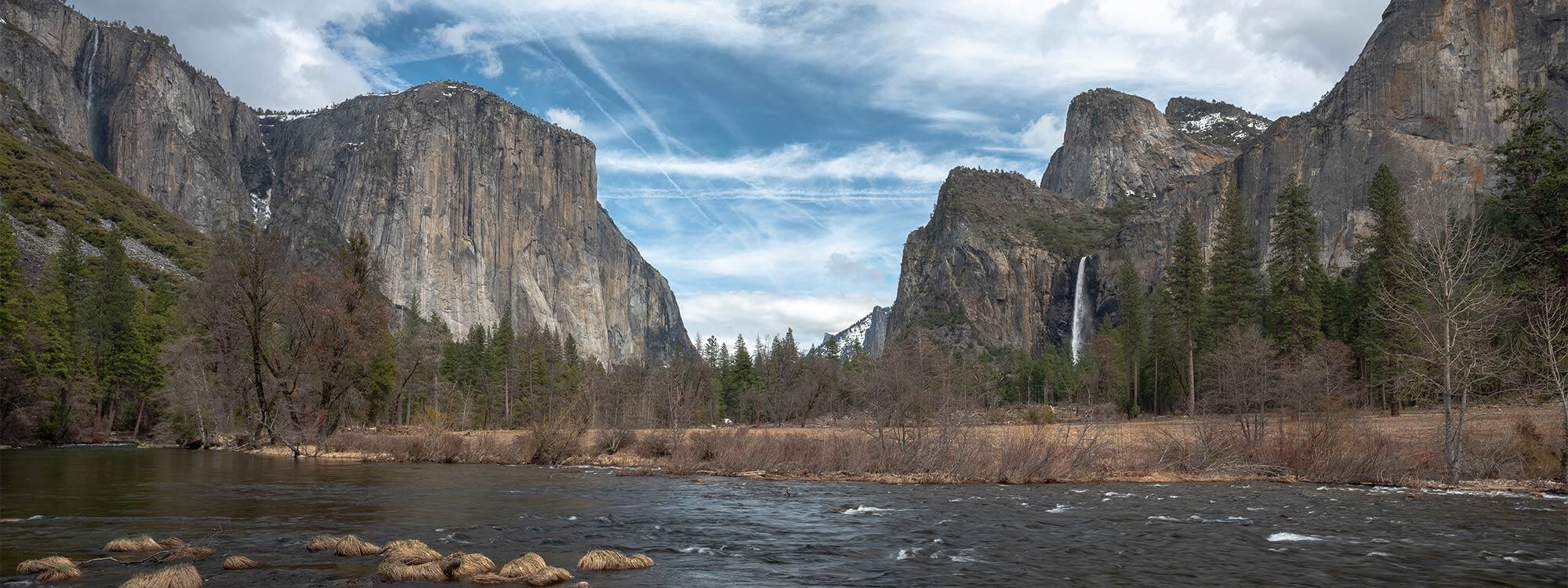
For the next stop, Paul Reiffer had planned to photograph the so-called "Tunnel View" – a spectacular panoramic view into the Yosemite Valley basin.

Subject: Yosemite National Park, California
Coordinates: L: 37.715 | B: -119.676
Filter: ND64 Neutral Density Filter, Medium GND16 Graduated Neutral Density Filter
Exposure: Aperture 18 at 60 seconds
Camera: Fujifilm GFX 50S
Lens: GF23mmF4 R LM WR
Here too, the team managed to position their cameras just in time for the impressive sunset. With an ND64 and a Medium GND16 in the rectangular filter holder, the wide-angle lens also let light fall onto the image sensor through the f/18 aperture for one minute.

#3: The Tufa Formations at Mono Lake
For the next day, a comparatively short drive to Mono Lake was originally planned. Unfortunately, the direct passage over Tioga Pass through the national park, known far beyond the USA, was still closed due to snow. Thomas Güttler and his companions therefore had to make a significant detour north, before finally being able to move into their accommodation exhausted, in the immediate vicinity of the soda lake.
Since 1941, water has been diverted from the vicinity of Mono Lake via a 520-kilometer pipeline to supply the residents of Los Angeles. This considerable continuous extraction caused the water level of the lake to drop steadily, the salt content to increase sharply, and over the years, a popular photo motif of bizarre tufa formations formed – which developed into true tourist and photographer magnets.
In the middle of the lake stands a particularly impressive formation, which was chosen by the Rollei team as the main motif for their two-day stay. Under dramatic clouds, the lake appears absolutely surreal thanks to an exposure time of 30 seconds and the use of a CPL (polarizing filter) and ND filter (strength 64) filters.

Whereas the identical scenery before a spectacular sunset attracts our attention more like the backdrop of a fantasy or science fiction film. Here, the team used an ND8– and a Soft GND8-slot-in filter and opened the blades of the f/22 aperture for 10 seconds.

Subject: Mono Lake, California
Coordinates: L: 37.943 | B: -119.027
Filter: ND8 Neutral Density Filter, Soft GND8 Graduated Neutral Density Filter
Exposure: Aperture 22 at 10 seconds
Camera: Fujifilm GFX 50S
Lens: GF23mmF4 R LM WR

But it gets even more dramatic:

Subject: Mono Lake, California
Coordinates: L: 37.943 | B: -119.027
Filter: ND64 Neutral Density Filter
Exposure: Aperture 11 at 60 seconds
Camera: Fujifilm GFX 50S
Lens: GF23mmF4 R LM WR
This picture actually seems to be completely out of this world and to have been transmitted by the Mars Rover Opportunity.

#4: Devil's Golf Course in Death Valley
The next photographic subject also had something to do with salt: in the middle of the bone-dry and up to 50-degree hot Death Valley lies the so-called "Devil's Golf Course" – a dried-up lake whose flat bottom is covered for miles by razor-sharp salt crusts.
Indeed, some tourists repeatedly take pleasure in hitting a few golf balls – but for understandable reasons, they refrain from collecting their plastic balls again. The Rollei team was more environmentally friendly and took some absolutely impressive shots with the panorama head, an f/11 aperture, an exposure time of only 1/160 s and a focal length of 32 mm.
The screw-in professional polarizing filter in the rectangular filter holder also ensured the rich blue of the sky and the increased contrast range.

Subject: Death Valley, Arizona
Coordinates: L: 36.285 | B: -116.826
Filter: CPL Filter
Exposure: Aperture 11 at 1/200 second
Camera: Fujifilm GFX 50S
Lens: GF23mmF4 R LM WR
#5: Zabriskie Point in Death Valley
Before the USA trip ended as planned in the gambling city of Las Vegas, Thomas Güttler and his companions made a detour to the well-known Zabriskie Point in Death Valley.
A wonderful photographic subject, where an exposure time of 10 seconds and a slotted-in Soft-GND8 filter were sufficient to capture the overwhelming atmosphere and the unique color spectrum with the Panorama Head 200:

Subject: Death Valley (Zabriskie Point), Arizona
Coordinates: L: 36.420 | B: -116.812
Filter: Soft GND8 Graduated Neutral Density Filter, ND8 Neutral Density Filter
Exposure: Aperture 8 at 0.4 seconds
Camera: Phase One IQ4
Lens: Schneider Kreuznach 35 mm LS 3.5 Blue Ring
Conclusion
The new Rollei F:X PRO Rectangular Filters have impressively demonstrated their unrestricted readiness for use – and comprehensive temperature resistance. Thanks to the extremely durable sealing, even the finest desert sand with "continuous exposure" could not harm the slot-in filters.
Thomas Güttler and his team finally flew home with the absolute certainty of being able to provide demanding Rollei customers with uncompromising premium quality again with this new generation of rectangular filters.
*Note: Gorilla Glass® is a registered trademark of Corning and is used by Rollei for filters – all naming rights belong to Corning.

Share:
Long Exposure Photography: The Complete Guide to Long Exposure Times
3 Methods for Impressive High-Speed Photography