
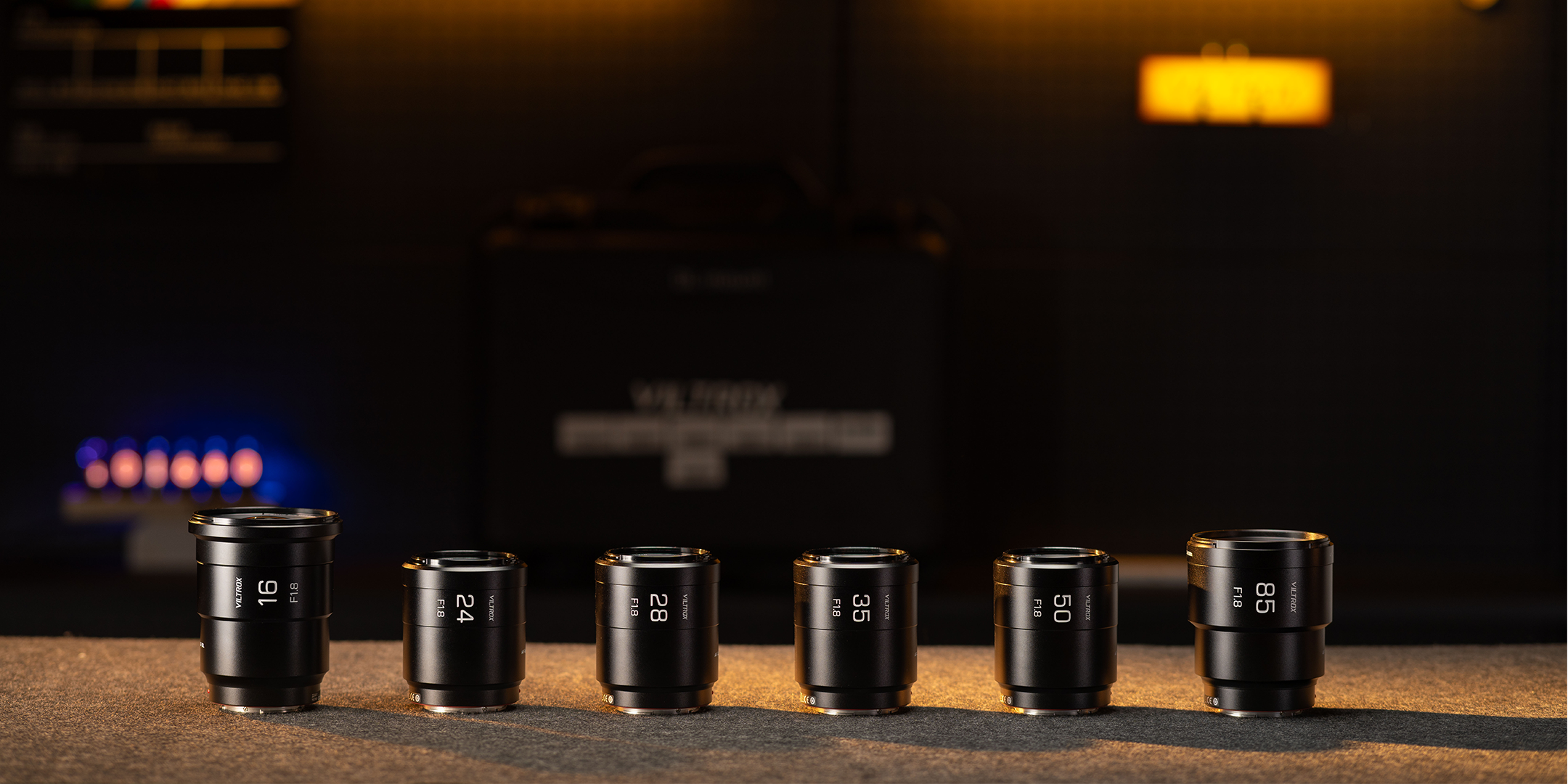
If you are new to the world of photography or videography, choosing the right lens can be a challenge. The focal length of a lens determines how much of the scene you can capture and how far away objects appear. Together with Viltrox, we offer you a range of lenses suitable for various needs and styles. In this post, you will learn which focal lengths are best suited for different subjects and how to choose the right lens for your needs.
What is Focal Length?
The focal length of a lens is a fundamental concept in photography, referring to the distance between the lens and the focal point. It is measured in millimeters and influences the depicted perspective.
Focal length is the distance between the lens and the point where light converges, known as the focal point. Light rays passing through the lens meet at this focal point. The focal length determines how much the image is magnified or reduced. A long focal length brings distant objects closer, while a short focal length shows more of the surroundings. In cameras, the focused light hits the sensor, which captures the image.

Prime Lens vs. Zoom Lens: What's What and Why Are Prime Lenses So Popular?
With a prime lens, the field of view cannot be changed; it always captures the same angle of view. In contrast, with a zoom lens – as the name suggests – you can zoom in and out, thereby reducing or enlarging the field of view. These offer greater flexibility compared to prime lenses. However, this comes at the expense of image quality: a zoom lens covers a wide range of focal lengths, which can introduce image defects. Prime lenses deliver optimal image quality and light intensity, allowing for better bokeh effects, for example. Furthermore, they are smaller, more compact, and often more affordable than zoom lenses, and depending on the focal length, they are suitable for specialized fields.
Lens Overview
Super wide-angle (under 24 mm): Lenses with a very short focal length (e.g., 13 mm to 24 mm) belong to the super wide-angle lens category. These offer an extremely wide angle of view and are ideal if you want to capture even more of the scene. They are particularly useful for dramatic landscape shots, architecture, or tight interiors where you need a particularly large field of view.
Super wide-angle lenses can also create creative effects by offering pronounced perspective distortion and a strong spatial effect.
Ideal for: Landscapes, astrophotography, tight interiors
Our tip: AF 13 mm F/1.4 lens
Viltrox AF 13 mm F/1.4 DX lens with Nikon Z-Mount – Rollei
Viltrox AF 13 mm F/1.4 E lens with Sony E-Mount – Rollei

Wide-angle (under 35 mm): A lens with a short focal length (e.g., 24 mm or 35 mm) has a wide angle of view. This means it captures more of the scene, and objects further away appear smaller. Such lenses are ideal for landscape and architectural photography, for example.
Ideal for: Landscapes, architecture, indoor shots
Our tip: AF 27 mm F/1.2 Pro lens
Lens | AF 27 mm | F/1.2 Pro XF | Fuji – Rollei
AF 27 mm F/1.2 Pro lens for APS-C cameras with Nikon Z-Mount – Rollei
AF 27 mm F/1.2 Pro E lens for Sony with F/1.2 aperture – Rollei

Standard focal length (35 mm - 70 mm): A lens with a medium focal length (e.g., 50 mm) is also called a normal focal length, because it offers an angle of view that is quite close to the human field of vision. This makes it easier to focus on the main subject and quickly develop a feel for the right composition and perspective. Therefore, the normal focal length is particularly suitable for beginners.
Standard focal lengths are generally very versatile and suitable for everyday shots, portraits, and street photography, as they offer a natural perspective.
Ideal for: Portraits, everyday photography, landscape photography, street photography
Our tip: AF 50 mm F/1.8 lens
Viltrox AF 50 mm F/1.8 FX lens with Nikon Z-Mount – Rollei
Viltrox AF 50 mm F/1.8 FE lens with Sony E-Mount – Rollei

Telephoto lens (70 mm – 200 mm): A lens with a long focal length (e.g., 85 mm or 200 mm) has a narrower angle of view and can bring distant objects closer. This is useful for photographing animals, sporting events, or close-ups, as it allows you to magnify and focus on distant subjects. Lenses with a focal length of 70 mm to 85 mm are also very well suited for portrait photography.
Ideal for: Wildlife photography, sports photography, close-ups, portraits
Our tip: AF 75 mm F/1.2 Pro lens
Lens | AF 75 mm | F/1.2 Pro Z DX | Nikon Z-Mount – Rollei
Lens | AF 75 mm | F/1.2 Pro | Sony E-Mount – Rollei

Lens Special Features:
Macro lenses: A macro lens allows for high magnification at a short close-up distance, as they generally have a significantly shorter minimum focusing distance than normal lenses. You can get incredibly close to your subject and still get high-resolution images. It is specifically designed to capture tiny details. Additionally, macro lenses can create a shallow depth of field to highlight the subject. Macro lenses typically have focal lengths between 50 mm and 200 mm. The longer the focal length, the greater the distance to the subject can be. This is suitable, for example, for photographing insects, which are often very skittish.

© Stephan Wiesner
Super telephoto lenses (300 mm and above): These lenses bridge very large distances when it comes to capturing a subject at large magnification. Therefore, they are particularly well-suited for safari photography, for example, when you cannot get close to a subject. They are also used in sports photography, for instance, when a footballer in a very large stadium needs to be photographed. With a focal length of this magnitude, the shallow depth of field makes it very easy to isolate the subject from both the foreground and background, so that, for example, in wildlife photography, a bird can still be sharply depicted despite obstacles such as bushes and branches. However, it must be noted that lenses become very heavy with increasing focal length.
Additional aspects of focal length:
Depth of field: A longer focal length can reduce the depth of field (i.e., the area in the image that is sharply rendered). This means that the background becomes blurred, creating so-called bokeh effects, which is particularly advantageous for portraits or for isolating subjects from the background.

The aperture: The aperture allows you to control how much light falls on the sensor. It also plays a big role in depth of field. The wider the aperture is open, the less depth of field is created. If the aperture value is very small, for example f1.8, the aperture is wide open. The higher the value in the setting, the more the aperture is closed, for example f18. The aperture is also very important for the exposure of the subject. The more the aperture is closed, the less light the sensor can capture. This can result in the image being underexposed or blurred.
Perspective distortion: Short focal lengths can lead to greater perspective distortion, meaning objects in the corners of the image may appear more distorted. Long focal lengths minimize this distortion and bring distant objects closer.
For a visual representation of focal lengths and their angles of view, please see the following graphic:

Conclusion:
The choice of the right Viltrox lens depends on your photographic style and requirements. Whether you want to create breathtaking landscapes, detailed macro shots, or impressive portraits, Viltrox offers the perfect lens for every occasion. Discover the variety of Viltrox lenses and find the model that best suits your creative vision.Want to be the first to know about news? Then follow us on Instagram, Facebook or TikTok
... and also discover Viltrox Germany on Instagram

Share:
Magnetic Circular Filters for Photography: More Than Just a Technical Gadget
Game-Changer Ring Light – Versatile for Perfect Shots